
December 29th, 2025
Building a Bridge for Exchanges Between Eastern and Western Civilizations
(From news.163.com) As global transformations accelerate and the need for inter-civilizational dialogue grows more urgent, Singapore, with its unique strategic positioning and culturally diverse and inclusive foundation, has become a "natural bridge" connecting Eastern and Western civilizations. In 2025, Xiao Wunan, Executive Vice Chairman of the Asia Pacific Exchange & Cooperation Foundation (APECF), led multiple delegations to Singapore. He engaged in in-depth talks and cooperation consultations with representatives from the Asia-Pacific Economic Cooperation (APEC), the Pacific Economic Cooperation Council (PECC), as well as Singapore's academic, business, cultural, and political circles.
Singapore's role in promoting exchanges between Eastern and Western civilizations stems from its irreplicable comprehensive strengths. As a geopolitical hub in Southeast Asia, it is not only a key node on the Maritime Silk Road but also a convergence point for personnel exchanges, material circulation, and ideological collisions. Its governance model, which integrates Western rule of law spirit with Eastern collectivist values, not only ensures social stability but also provides ample space for the growth of diverse cultures, offering a valuable example for the coexistence of global civilizations.
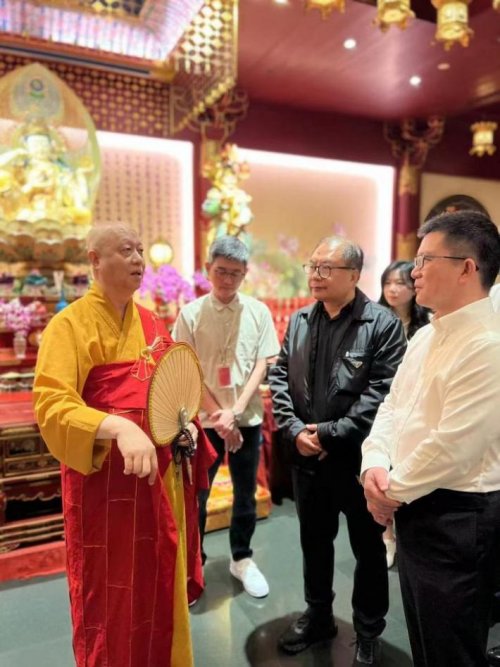
Venable Master Shi Fazhao (left) of Singapore's Buddha Tooth Relic Temple exchanges with guests including Xiao Wunan (second from right)
The APECF has always been committed to promoting exchanges and cooperation between Eastern and Western civilizations in various fields. Over the years, it has actively promoted several influential inter-civilizational dialogue activities. Among them, the "Promote World Peace through Dialogue among Civilizations" initiative, launched in Los Angeles, USA in 2014, has been held in over ten countries and regions, garnering widespread international response. Vice President of the United Nations General Assembly Arthur Kafiero hosted a special session at the UN Headquarters, deciding to include this theme as an important part of the UN's "Post-Millennium Development Goals" and incorporate it into the General Assembly's agenda for that year. The APECF recognizes Singapore's unique value in global inter-civilizational dialogue and has long established regular communication mechanisms with various parties to advance the implementation of consensus and the translation of outcomes.
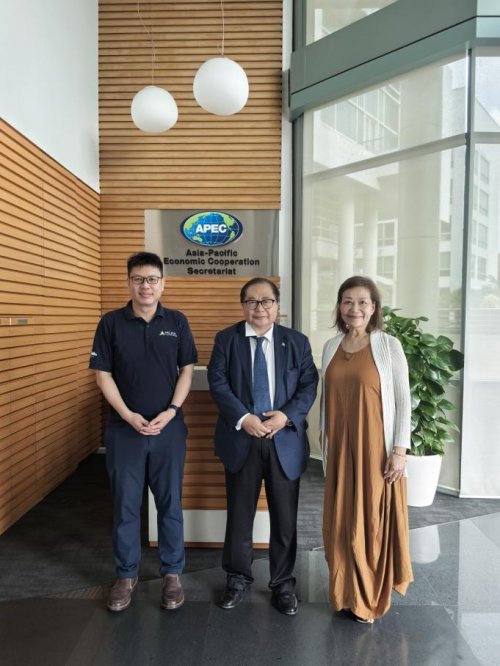
Representative of APEC Secretariat (first from left), Xiao Wunan (center), and Zhan Manrong (first from right)
On June 17, the delegation visited the APEC Secretariat and held closed-door talks with its leadership. The two sides exchanged views on issues such as Asia-Pacific regional economic integration, green sustainable development, and digital economic cooperation. APEC introduced its platform advantages and shared information about the innovative addition of a cultural theme forum at the recent APEC Summit in South Korea. During the talks, APEC proposed that as China will be the guest of honor at the 2026 APEC Forum, it hopes the Foundation will play a bridging role to inject more vitality into multi-level cooperation in the Asia-Pacific region.
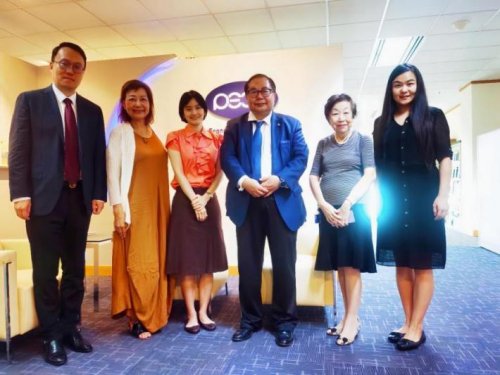
PECC Secretary General Kaewkamol Karen Pitakdumrongkit (third from left), Xiao Wunan (third from right), and Wang Wei (first from right) in the meeting
Subsequently, the delegation visited the PECC Secretariat and held discussions with Secretary General Kaewkamol Karen Pitakdumrongkit and her core team. Xiao Wunan elaborated on the cooperation concept of "Strengthening Asia-Pacific Mutual Trust Through Cross-Cultural Understanding," hoping to leverage PECC's advantages to promote in-depth collaboration among Asia-Pacific countries in areas such as cultural inheritance and innovation, ecological environmental protection, and youth talent exchanges. The two sides reached important consensus on these issues.
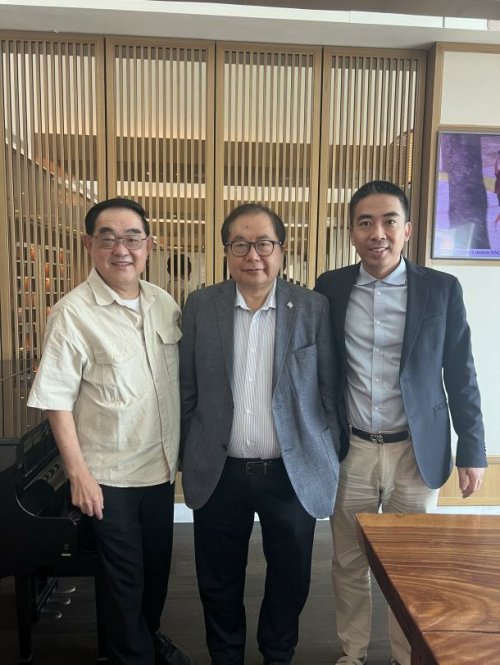
Famous Singaporean scholar Dr. Koh Hock Kiat (first from left) meets with Xiao Wunan (center)
On June 18, the delegation focused on cultural and academic cooperation. Xiao Wunan and renowned Singaporean scholar Professor Koh Hock Kiat held special discussions on the preparation of the "Center for Asian Business Leadership Studies." The two sides conducted in-depth consultations on issues such as the construction of the research center's academic system, the setting of core research directions, and the integration of international expert resources, and formulated an initial work schedule for the center.
During the noon break, Xiao Wunan led the delegation to meet with George Yeo, former Foreign Minister of Singapore. They engaged in in-depth exchanges on topics such as the modern transformation of traditional culture, the contemporary value of dialogue between Eastern and Western civilizations, and Eastern wisdom in global governance. Combining his decades of experience practicing Tai Chi, George Yeo vividly explained the inherent connection between Eastern cultural concepts such as "Yin-Yang Balance" and "Integration of Hardness and Softness" and the contemporary world—cultural exchange is not about simple assimilation but about achieving mutual prosperity through mutual understanding and inclusiveness.
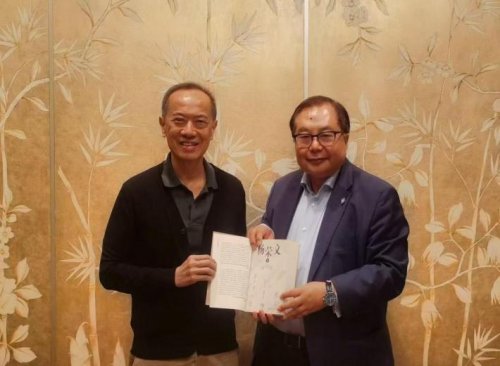
George Yeo (first from left), former Foreign Minister of Singapore, presents his personal works to Xiao Wunan
Zhan Manrong, former head of an APEC department, Wang Gang, President of the Singapore Shaanxi Chamber of Commerce, Dong Chao and Wang Chongyang, heads of Beijing Beika Technology Co., Ltd., and Wang Wei, APECF Representative in Singapore, participated in the above activities.
Currently, the world is facing multiple challenges such as geopolitical conflicts, ecological environmental crises, and development imbalances. The ancient Eastern wisdom of "Harmony and Coexistence" and "Unity of Man and Nature" provides a valuable ideological source for resolving differences and reshaping the global order. Deepening exchanges and mutual learning between Eastern and Western civilizations with Singapore as a base has become a common expectation of the international community. The APECF will remain committed to this goal and continue to make unremitting efforts to advance the process of Asia-Pacific regional integration and improve the global governance system.
 Back
Back