
November 20th, 2025
Building a New Mechanism for China-Latin America Cooperation
(From sz.ifeng.com) Though separated by thousands of miles, China and Latin America share a natural affinity in historical origins and cultural identity. In recent years, China-Latin America economic and trade relations have grown increasingly dynamic, making the development of a new mechanism for exchanges and cooperation between China, Spain, and Latin America more imperative than ever. The Asia Pacific Exchange & Cooperation Foundation (APECF) has long been committed to fostering regional exchanges and cooperation, maintaining strong trust with relevant stakeholders, and actively advancing, developing, and implementing this cooperation mechanism, which has already achieved phased outcomes.
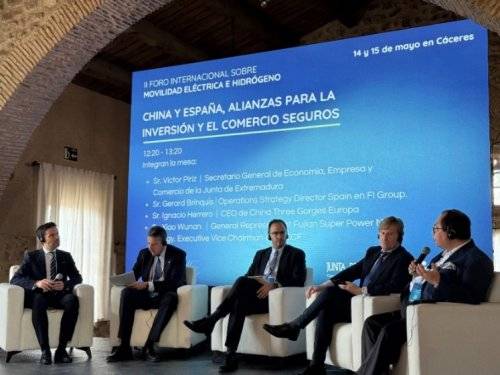
Xiao Wunan (first from right) delivers a speech at the 2nd International Forum on Electric Vehicles and Green Hydrogen in Spain
Since the start of this year, Xiao Wunan, Executive Vice Chairman of the APECF, has led delegations on multiple visits to Spain, Mexico, Panama, Peru, the Dominican Republic, and other countries. These visits focused on discussing how to leverage the cooperation mechanism to better support Chinese enterprises in "going global", yielding fruitful results.
In May, at the 2nd International Forum on Electric Vehicles and Green Hydrogen held in the Extremadura Region of Spain, Xiao Wunan delivered a keynote address. He emphasized the role of Spain as a bridge to advance China-Latin America cooperation in the new energy vehicle sector and build an industrial ecosystem across the Spanish-speaking world. His remarks drew significant attention from attendees and were widely reported and commented on by local mainstream media. The head of the Extremadura Region spoke highly of the proposal, stating that the region is ready to serve as the first stop for Chinese enterprises entering the Spanish market.
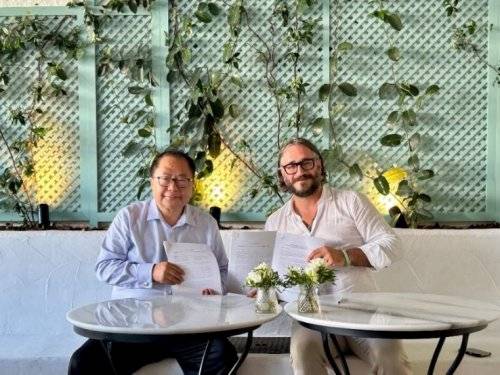
Xiao Wunan signs a cooperation agreement with Sergio Fernández de Córdova (right)
In June, Xiao Wunan led another delegation to Marbella, Spain, where he reached further consensus with the World Nature Development Bank team on optimizing the cooperation mechanism. High-level agreement was reached on issues including South-South cooperation, climate change response, and the creation of a new development model that enables underdeveloped countries to embrace Web 3.0 directly, with a memorandum of cooperation signed. The APECF has multiple times used Spain as a link to coordinate Latin American affairs, achieving notable results. During its visit to Mexico, the delegation held constructive exchanges with the Mexican President and the Chamber of Deputies, reaching consensus on multilateral cooperation. In meetings with key officials of Mexico City, the two sides agreed on a range of initiatives related to the city's future infrastructure development, particularly in livelihood projects.
In Panama, the delegation met with former President Martín Torrijos and reached broad consensus on future cultural and economic cooperation between China and Panama. Both sides agreed that, given the current context, promoting non-governmental economic, trade, and cultural exchanges is of special significance in addressing certain challenges and obstacles in bilateral relations.
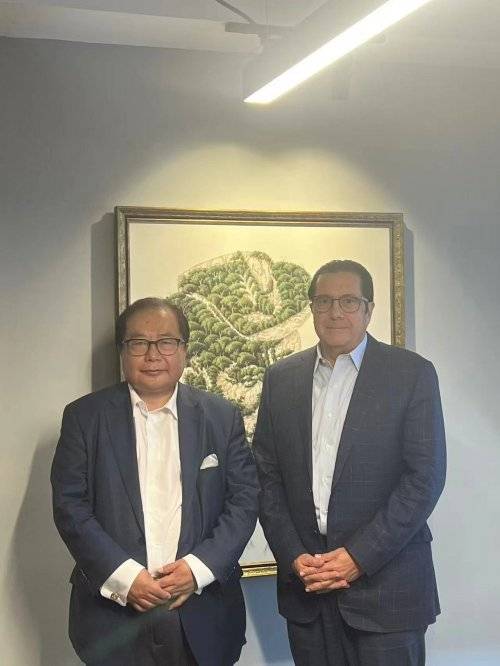
Xiao Wunan meets with former Panamanian President Martín Torrijos (right)
During the visit to Peru, the delegation engaged extensively with Peruvian political and business figures. In discussions with local Chinese-funded enterprises such as the Industrial and Commercial Bank of China, the participants agreed that, against the backdrop of strong China-Peru political relations, the time is ripe to advance bilateral economic, trade, and investment cooperation. In particular, cooperation in agricultural bulk commodity trade enjoys a solid foundation of mutual benefit and broad market prospects. In talks with prominent politician Luis Alberto Taís Díaz, he offered valuable insights on China-Peru cooperation, stating that Peru is willing to act as a "forerunner" in Latin America's relations with China and play an important role. He also put forward positive suggestions on Peru's infrastructure development, including the operation and management of existing ports, the development of surrounding industries, and future infrastructure planning.
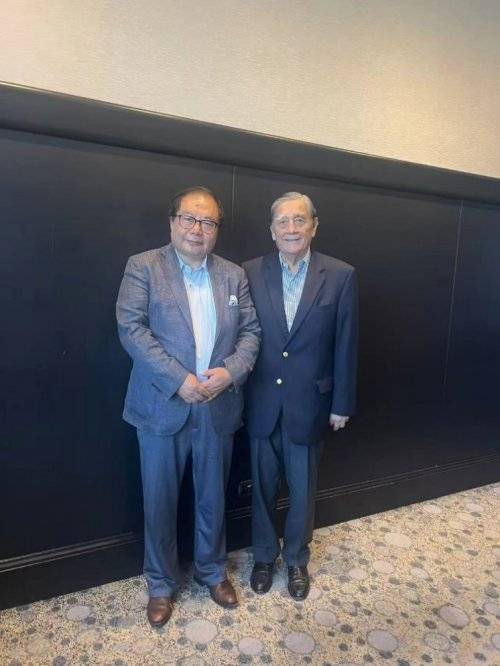
Xiao Wunan poses for a photo with prominent Peruvian politician Luis Alberto Taís Díaz (right)
In the Dominican Republic, the delegation held multiple meetings with Juan José Alteya, former economic advisor to the President, the Minister of Commerce, the Minister of Agriculture, and the head of the Tobacco Regulatory Agency. It also held discussions with leading enterprises in the coffee, cigar, and avocado sectors, reaching broad consensus on deepening cooperation in these areas. Notably, an agreement was reached on cigar tobacco cultivation, laying the groundwork for upgrading the quality of Chinese cigars.
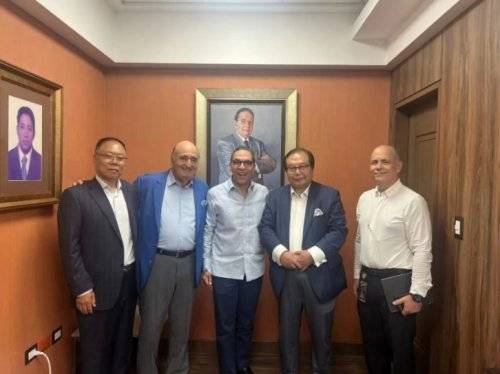
Xiao Wunan (second from right) meets with Juan José Alteya (second from left), former economic advisor to the Dominican Republic's President, and the head of renowned coffee company INDUBAN (center), among others
By leveraging this cooperation mechanism, China and Latin America are gradually exploring new models of collaboration. It is believed that the development of this mechanism will not only significantly boost regional economic growth and help address major global challenges, but also play a positive role in resolving global issues such as poverty, environmental protection, and peace.

Xiao Wunan meets with Dominican Minister of Agriculture Limber Cruz (right)
 Back
Back